Jeff Hobbs
The Short and Tragic Life of Robert PeaceJeff Hobbs is the narrator’s central witness to Rob Peace’s transformation from an apparently reserved Yale freshman into a widely connected, intellectually restless, and morally divided adult. He first approaches Rob through assumptions about race and class, but their friendship gradually becomes intimate enough for Hobbs to recognize the distance between their lives, the burden Rob carried between Newark and Yale, and the limits of his own understanding. After Rob’s death, Hobbs turns that friendship into a sustained act of reconstruction, using conversations with Rob’s family and friends to build the book’s bridge between two worlds.
Identity and Background
Jeff Hobbs arrives at Yale from Kennett Square, Pennsylvania, after attending private school from prekindergarten onward and growing up in a stable, affluent family. His parents have been married for almost thirty years, and his childhood includes sports camps, annual school-clothes shopping, spring trips to Florida, two Labradors, and a pool behind the family home. He is also a national-caliber hurdler, a distinction that earns him the Gardner Millett Award at Yale, and he studies English language and literature.
His background initially remains partly concealed from Rob. Hobbs tells Rob that he grew up “near Philly,” while omitting the farmhouse, the fifteen acres, the private schooling, and the family security that have shaped him. The omission is deliberate: he wants to appear comfortable among urban Black men and to establish himself as a plausible friend to a roommate whose experience he does not yet understand. His self-presentation exposes both good intentions and insecurity. He is not merely observing the Newark–Yale divide; he is trying to disguise the side of it from which he comes.
Meeting Rob at Yale
Hobbs first contacts Rob in the summer before Yale, writing that they will be roommates and suggesting that they coordinate their furnishings. Their first telephone conversation is awkward and brief. Adult voices argue in the background at the Peace home, and Rob tells them to quiet down before speaking in a deep, unusually resonant voice marked by long silences. Hobbs learns that Rob attended St. Benedict’s Preparatory School, played some water polo, and loved hiking the Appalachian Trail. Nothing in the conversation initially identifies him as anything other than a polished Yale applicant, although the gravity of his voice suggests a seriousness that Hobbs cannot yet explain.
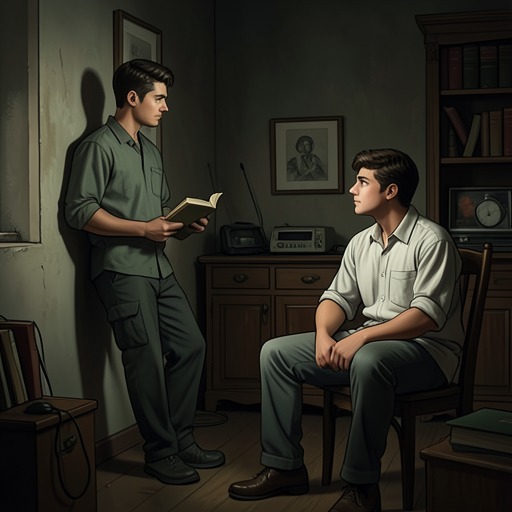
Their move-in meeting makes the contrast sharper. Hobbs enters the fourth-floor quad in Lanman-Wright Hall amid the frantic noise of freshman arrival and finds Rob and Jackie Peace sitting almost motionless, as though interrupted in a scene whose importance he cannot yet grasp. Rob has only one duffel bag, a small bunny-eared television, jeans, and a T-shirt. At the first gathering of the Pierson Class of 2002, he stands apart in baggy jeans, Timberland boots, and a black skully, smoking with his back turned to the group. Some classmates mistake him for dining-hall or maintenance staff, and Rob does little to correct them.
Hobbs, by contrast, initially treats his Black roommate as a kind of social credential. Because he has traveled with mostly Black runners at Junior Olympic meets, knows popular hip-hop, understands some street slang, and plays spades, he considers himself an “honorary black man.” He seeks Rob out in the dining hall and drops hints about his supposed familiarity with urban Black life, even though their families, neighborhoods, and economic circumstances are fundamentally different. Their friendship therefore begins not with easy recognition but with performance, uncertainty, and a gradual discovery of difference.
Friendship and Observation
The relationship develops slowly. Hobbs remains wary of becoming too close too quickly, following an uncle’s advice that it is easier to deepen a friendship than to escape an unsuitable one. Rob does not expose Hobbs’s evasions, whether from sensitivity or amusement, and the two initially connect through the apparent oddity of their pairing: a white sprinter and a Black water-polo player. Over time, however, Hobbs watches Rob become a beloved presence across Yale.
Rob’s circle includes Danny Nelson, Yesenia Vasquez, Nick Crowley, teammates, science classmates, Weed Shack associates, and many others. Raquel, Daniella, and Oswaldo Gutierrez become especially close to him, speaking with him respectively about family, classes, and home. Hobbs recognizes that these friendships are deeper than his own and consciously avoids intruding, even while feeling jealous. His jealousy is tempered by the fact that Rob saves him twice during their sophomore year, demonstrating a loyalty that does not depend on Hobbs’s privileged background or his attempts to conceal it.
Hobbs also observes how Rob uses marijuana as a bridge between his Newark life and the Yale world. Rob hides his smoking effectively, never smokes in their room, and often studies with the television and music playing loudly. Hobbs interprets this behavior as a personal quirk rather than recognizing its connection to Rob’s drug dealing and divided identity. The narrator’s delayed understanding is crucial: he is close enough to see Rob’s habits but not close enough, at first, to read their full meaning.
Literary Preoccupations and Narrative Limits
During senior year, Hobbs’s academic work repeatedly returns to the search for the father. In a class taught by Harold Bloom, he writes about Odysseus and Telemachus; his senior thesis examines the biological and surrogate fathers in James Joyce’s Ulysses; and his creative-writing project follows a son searching for an abandoned father after his own son’s death. Together, these projects total roughly 150,000 words. The recurrence of fathers in his work becomes an unconscious counterpart to Rob’s life, in which Skeet Douglas’s imprisonment, appeals, and eventual death remain an organizing force.
Hobbs does not fully understand that connection while living beside Rob. When Rob asks how he can simply sit and write, the question cuts across the room’s ordinary student life and exposes the different pressures shaping them. Hobbs can devote himself to literary production within a secure family structure; Rob is simultaneously negotiating Yale, Newark, marijuana, and the legal fate of his father. Hobbs’s writing therefore gives him language for paternal absence before he possesses a complete understanding of the real absence beside him.
His narration remains self-correcting rather than omniscient. He openly identifies his own omissions, jealousy, class privilege, and mistaken interpretations. He once assumes that marijuana is merely Rob’s private link to home; only later does he learn that Rob made more than $100,000 selling it at Yale. This retrospective structure lets Hobbs preserve the uncertainty of the period while also acknowledging the ways his earlier judgments were incomplete.
From Friend to Biographer
After Rob’s death, Hobbs’s friendship becomes an investigative responsibility. Oswaldo Gutierrez tours him through the physical and emotional landmarks of Newark and Yale, helping him understand the invisible burden borne by people who inhabit both places. The book’s central bridge is therefore not simply geographic. It is made from the testimony of people who knew Rob in different settings and understood different portions of his identity.
The project begins as what Hobbs intends to be a short, cathartic visit with Raquel Diaz soon after Rob’s funeral. Instead, the conversation lasts eight hours in her living room in Spanish Harlem while rain falls outside. Raquel’s questions and insights remain close to the book’s formation, turning grief into inquiry. Hobbs also receives the trust of Nathan, Carl, Diandra, Cory, Dante, Garcia, Camilla, and the wider Peace family, who invite him into their homes and share their memories.
Jackie Peace becomes especially important. Hobbs says that she spends dozens of hours speaking with him during the hardest years of her life, discussing the son whose loss has defined those years. His gratitude toward her is personal as well as documentary: he describes himself as fortunate to have been able to call Rob his friend. The final book is thus presented not as detached reporting but as an attempt to earn the trust granted by Rob’s family.
Career and Narrative Significance
Hobbs’s later career confirms the development from roommate into writer. After graduating from Yale with a BA in English language and literature, he lives alternately in New York City and Tanzania for three years while serving as executive director of the African Rainforest Conservancy. His novel The Tourists is published by Simon & Schuster in 2007, and he later lives in Los Angeles with his wife and two children.
Within the narrative, Hobbs functions as both participant and interpreter. He shares a room, a campus, and a friendship with Rob, yet his secure upbringing prevents him from fully occupying Rob’s experience. That partial access gives his account its tension. He can describe Rob’s voice, silences, clothes, habits, friendships, and gestures from close range, but he must repeatedly revise what those details mean. The result is a portrait shaped by belated knowledge: the friend who once stood at the edge of Rob’s deeper relationships becomes the person who gathers those relationships into a larger account.
Hobbs’s importance ultimately lies in the ethical problem he makes visible. To write about Rob is to cross the same Newark–Yale divide that Rob crossed, but without pretending that observation is the same as belonging. Hobbs’s narrative authority comes not from claiming complete access but from exposing the distance between what he saw, what he believed, and what he later learned. His work preserves Rob’s contradictions while also preserving the friendship that made the effort to understand him possible.